AMD model (accumulation — manipulation — distribution)
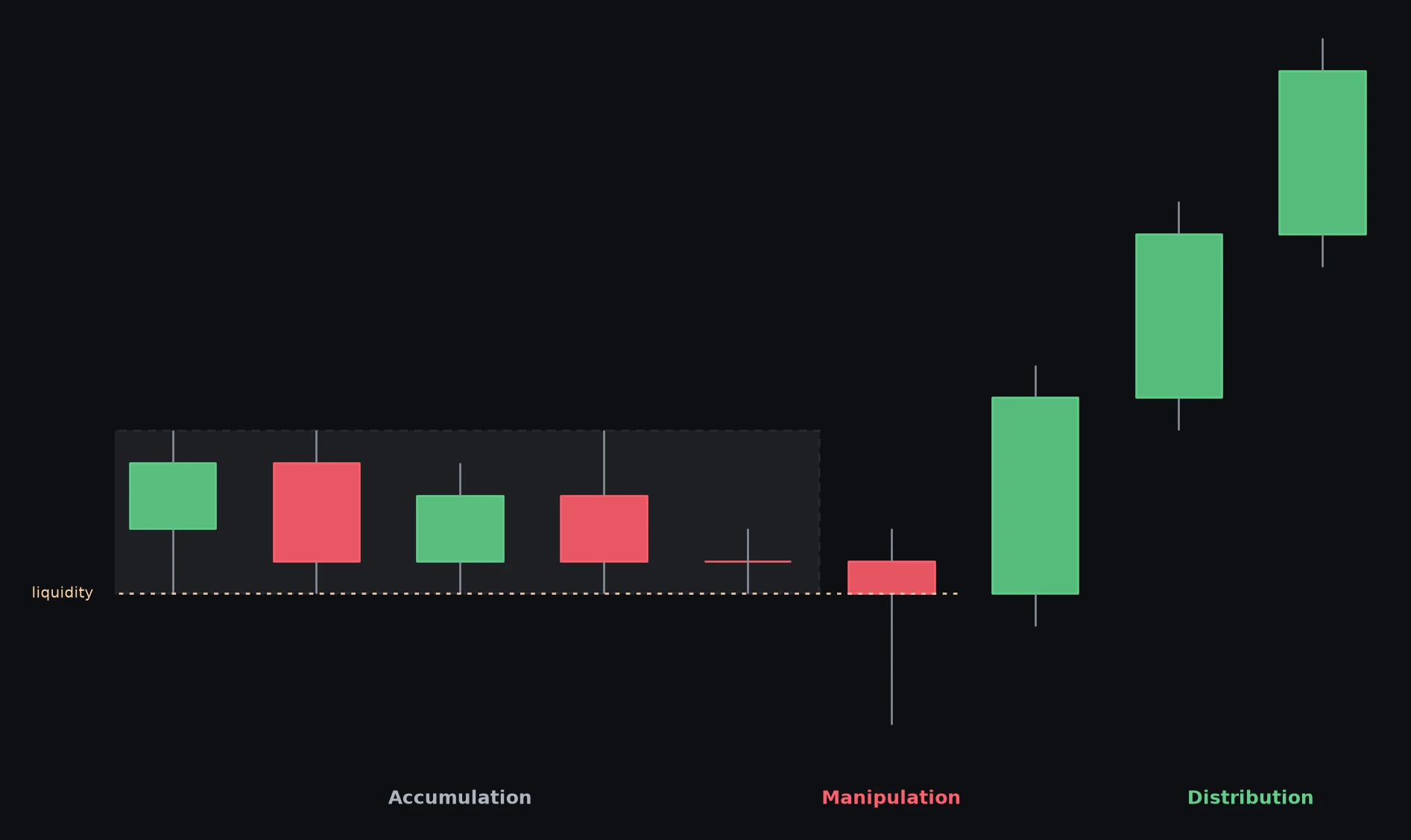
The AMD model (accumulation — manipulation — distribution) describes how price builds a directional move in three sequential phases rather than a single impulse. The same model is often called the Power of Three. First comes accumulation, then a sharp counter-trend move — manipulation — and only after that the main trend move, distribution.
Accumulation is when a large participant builds a position. Before the move continues, available liquidity is taken deliberately: the stop orders of range participants are run and used as fuel to drive price along the higher-timeframe trend. To read AMD correctly, you first define the trade range boundaries (where the impulse begins and ends), then locate the accumulation phase inside it; intraday, accumulation usually forms during the Asian session while manipulation tends to land on the London session.
In the FocusProfit methodology, AMD is the entry logic: the Trade Model indicator maps ranges and structure so the accumulation boundaries and the manipulation window are easier to see. The manipulation phase is confirmed by three arguments (imbalance inversion, a V-shaped reclaim of more than 30% of the impulse, and a higher-timeframe liquidity grab inside the zone of interest), after which the distribution phase is expected.
Read the breakdown
Related terms
SYSTEMATIC WORK WITH THE MARKET
This material is open: no application, nothing to pay. There is one paid product — the Trade Model indicator, and it is not on sale right now: we are taking signups for the queue.
JOIN THE QUEUE